|
David Lean
Advertise This Page
Search Site
Ryan's Daughter Dvds @ amazon.com (direct link)
Ryan's Daughter Books @ amazon.com (direct link)
I loved his innocence, his bravura and his kindness,
David Lean signed items @ ebay.co.uk (direct link to signed items)
THE idea for Ryan's Daughter came from Robert Bolt, the celebrated
English playwright and long-term collaborator with David Lean.
Holidaying in Italy in 1968, Lean read the first draft, which was a
reworking of Flaubert's romantic novel Madame Bovary. It promised a
comparable visual style to their earlier films together, Lawrence of Arabia
(1962) and Doctor Zhivago (1965). Bolt was excited by its possibilities,
and the two of them worked energetically on the script for the next nine
months, at the end of which they discussed it with Anthony Havelock-Allen, the producer of Brief Encounter and several other Lean movies.
Although the location and period Flaubert had described were
abandoned in favour of Ireland during the Troubles of 1916, their
script owed much to the flavour and central characters of the nineteenth-century French novel. The saga of an unsatisfied young wife exchanging a dull husband for an ardent lover was familiar territory
for Lean. Subsidiary characters in the Flaubert novel, such as the girl's
father and a rumbustuous priest, were retained in a modified form,
and the leafy woodlands where the lovers meet were re-created in
Ireland for the notorious 'ride-in-the-woods' scene.
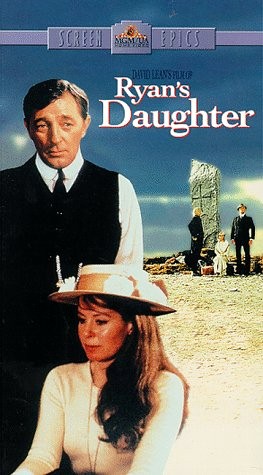
The film story was set in a tiny seaside village, Kirraray. The local
publican's daughter, Rosy Ryan, played by Sarah Miles (then Bolt's
wife) is infatuated with Charles Shaughnessy, a mild-mannered school-teacher played by Robert Mitchum. She coaxes him into marrying her,
but their wedding night and the ones that follow shatter her romantic illusions. The village priest, Father Collins, played by Trevor Howard, is
outraged when Rosy insists there must be more to marriage than what
she can find in hers.
'Why must there be? Because Rosy Ryan wants
it?' he roars at her.
She has a brief but tragic affair with a handsome British Army officer,
Major Doryan, played by Christopher Jones, whose time in the
trenches has left him morose and shell-shocked. Her husband has a
different kind of shock when he discovers what she's up to. As their
marriage heads for the rocks, so does Shaughnessy, but only to sit on
them and stare out to sea while he struggles to come to terms with
Rosy's infidelity.
When a shipment of weapons intended for Republican activists is
intercepted by British troops, everyone in the village suspects that Rosy
has tipped off her lover. They swarm around the schoolhouse, drag
her outside, rip off her outer clothes and crop her long hair. The
informer was actually her cowardly father, played by Leo McKern, who
diverts suspicion from himself by joining in the condemnation of Rosy,
although he hasn't the stomach to stay and witness her humiliation.
Later that night on the beach, a distracted Doryan blows himself to
pieces with some IRA explosives discovered there. The Shaughnessys
leave Kirraray for good, hoping to put the tragic events behind them.
The actress who would play the central role of Rosy was always going
to be Sarah Miles. The writer had created the role with his wife in mind.
Although she was twenty-five years old at the time playing someone
much younger, Bolt and David Lean were unanimous in their choice.
It had not always been that way. When they had collaborated on Doctor
Zhivago Lean had wanted Sarah in the role of Lara, because, he said,
she was the only actress he could name, apart from Celia Johnson, who
'acts with her eyes'. However, Robert Bolt, who at the time had not met
her and knew of her only through her films Term of Trial (1962) and
The Servant (1963), protested to Lean, 'You can't cast her. She's working class!' Later, when they met, Bolt realized that he had made a
terrible gaffe. Roedean-educated Sarah had deceived him by the quality of her acting.
Luring Robert Mitchum, their choice to play Shaughnessy, to
Ireland for the location shooting was not an easy task. The rationale
behind his selection never ceased to puzzle the American star. Arriving
in Ireland, he told reporters:
'Dunnowhy I'm playing an Irish schoolteacher. For a fraction of what they're paying me, they could have a real one.'
Sarah's first meeting with Mitchum was enough to accelerate any girl's heartbeat. He strolled into the production office wearing
large sunglasses and carrying a red rose. 'For you, my rose, with all my
love,' he said, without the merest hint of mockery. The man had style.
Most members of the cast, and much of the crew, were housed
around Dingle, a small coastal village in County Kerry, with a
picturesque harbour where rows of tiny fishing boats rode the tide.
Mainly as a result of the film, the place became a thriving tourist attraction and in economic terms it has never looked back. Bolt and Sarah
rented Fermoyle House, a spacious property twenty miles to the north
along a rugged road. While Bolt worked at the house on a new project
most days, its distance from the film location added extra hours to
Sarah's already long day. She said:
'We were, in a sense, lord and
lady of the manor, occupying this gracious house, but being so far from
the location I had to leave the house at four every morning! I would
have preferred a hotel nearer.'
Lean defended his choice of Mitchum, saying that:
'a quiet, smooth-sweet character actor in the part would have been totally wrong and,
even worse, deadly boring. Whatever one thinks of Bob Mitchum, he
has never been boring.'
Another reason might have been the large
quantity of US finance behind the film, for which an American star
would have been mandatory. Mitchum was a heavyweight, a safe name,
a crowd-pleaser with an enviable track record. But if he imagined that
this was just another rapid-shoot movie he could stroll through without touching the sides, he was heading for a big surprise.
Trevor Howard was not Lean's first choice to play the rough-and-ready
parish priest. Alec Guinness turned it down before Howard was considered. When Lean phoned him to inquire if he'd do another film with
him, remembering that his two previous roles for Lean had been as a
marriage wrecker, Howard said to him:
'Tell me one thing, David.
Whose wife do you want me to f@*k this time?'
After he read the script he began to understand why Guinness had
not liked the part. The priest seemed on the fringes of the drama,
always arriving after things had happened, but it was a take-it-or-leave-it offer and Lean wouldn't hear of expanding the role. In Ireland,
Howard said to Lean one day:
'You know, David, I'm only doing this
because of you.'
Lean was a bit taken aback, figuring that if there was any charity in
their relationship it had always come from his side. He said, 'Oh, come
on, Trevor. It's a bloody good part.'
Howard replied, 'It's a terrible part.'
Lean explained to Howard what he and Bolt wanted of the character and that he was not peripheral but right at the centre of things,
the strident voice of sanity and moral reason raging against infidelity,
bigotry and armed rebellion. For a canny director Lean was also a fine
salesman, and Howard went for the bait. Twenty years afterwards the
hook was still embedded in his mouth. He said:
'David gives all
the characters, not just the main ones, a job to do. The size of the part
isn't everything. Where it fits in the jigsaw also counts.'
One could almost hear Lean applauding in the background.
The arrival of the film crew delighted those in the town with goods
to sell or hire - rooms, drinks, transport and so on - at often triple or
quadruple their normal prices. One of the most popular bars in Dingle
is Paddy Bawn's (it has since been renamed Paddy Bawn Brosnan's).
On the inside it looks like a giant dog kennel, with dark wood as far as
the eye can see. The lighting is just bright enough to let you see that
you're not drinking someone else's beer.
Another murky alehouse is Dick Mack's on Green Street, which
heads north out of the village. Dick has decorated the flagstones
outside his pub with the names of his many famous clientele, among
them three of the stars of Ryan's Daughter - Mitchum, John Mills and
Christopher Jones. On one of the days I was there a funeral was taking
place in the church directly opposite Dick's place. It was barely three
in the afternoon, yet the drinking and chattering classes were already
three deep at Dick's solid wood bar. The arrival of the hearse drew a
few solemn-faced drinkers to the doorway of the pub, where they stood
silently, impassively, blinking against the strong sunlight.
Lean chose the coastline around the peninsula for its combination
of picturesque beaches and jagged mountains which in places drop
almost vertically into the sea. The village of Kirrary was built on a hill
called Maoilinn na Ceathrun, behind the village of Carhoo in Dunquin,
a parish whose only claim to fame before Ryan's Daughter was that it
was the most westward parish in the whole of Ireland. I have disappointing news for film buffs thinking of visiting the remains of Lean's
purpose-built village. It is, sadly, no more. The fronts of the houses
had been built of bricks and mortar and might have survived had a
group of local residents, fearful of an endless invasion of tourists, not
insisted that the structures be demolished when the film was finished.
The rugged locations have changed little since the film was made.
Shaughnessy is met by Rosy on his return from Dublin and later traces
her and Doryan's footprints in the sand, on Inch Strand, a wide stretch
of beach at right-angles to the snake-like coastal road between Dingle
and Siea Head, the most westerly point of the peninsula. Sometimes
the cameras skip several miles without the audience suspecting. The
opening sequence shows Rosy losing her parasol on a cliff top and it
being scooped out of the water below by two figures in a curragh, a
flat-bottomed boat used by Irish fishermen. She is actually standing
on the cliffs at Moher in County Clare when she loses the parasol, and
it is returned to her at Coumeenoole Cove in County Kerry, a distance
of forty miles.
The recovery of the arms shipment from the sea was also filmed
on Coumeenoole Cove, above which rises a steep, spiral stone road.
Here, too, the film-makers cheated. The sequence featuring the big
storm, which batters the crowds as they retrieve the arms from the sea,
was filmed at the Bridges of Ross, County Clare, an area famous for
its extraordinary rock formations, sixty miles from where the shipment came ashore. Comparing these locations then with now is an
interesting exercise. Coumeenoole Cove is the same today as it
appears in the film. Huge breakers pound the sand strip below the
rocks exactly as they did when Rosy poured her heart out to Father
Collins. Where Slea Head, another location in the film, slopes down
to the sea, the rocky shoreline today matches its celluloid image groove
for groove.
Filming began in March 1969, in the sea off Coumeenoole Cove.
Almost immediately the unit experienced its first near disaster.
Howard and John Mills had climbed aboard a curragh. It is a small,
nimble craft designed to skim over the water with comparatively little
oar-power. The problem is that a curragh without a cargo of fish is
tremendously unstable because, when empty, the hull barely dips
below the waterline. Even an experienced oarsman can have problems manoeuvring an empty curragh in choppy seas. By his own
admission, Mills was 'a fair-weather sailor', but with no dialogue in
the scene he hoped it would take only a few minutes to capture the
shot, and he felt confident that, with a bit of practice beforehand, he
would be able to manage it. Any longer and he would have had serious reservations.
While Mills rehearsed, the weather deteriorated. Lean was determined to complete the scene before conditions became too adverse.
Six handlers in frogmen's suits hauled the curragh, with Mills and
Howard squatting inside it, beyond the point where the waves broke
and waited for Lean's signal to release it. Howard peered at the churning water and said to Mills:
'I hope you know what you're doing,
Johnnie. This cassock weighs a bloody ton.'
By this time the winds
coming in from the Atlantic whipped up the surf, blinding the actors
and stinging their faces, but having taken hours to setup the shot Lean
insisted on a take.
Howard said:
'I didn't like it, but one doesn't argue with David
Lean. The man said, "Get in the boat," so I got in the bloody boat!'
When the frogmen released the curragh, it rocked uncontrollably. The
actors could do nothing but hang on grimly and hope that the cameras
were rolling.
Lean's behaviour shocked Sarah Miles. She said later:
'I was right there, beside the camera. Trevor's sense of balance is not his strong
point. It was a dangerous thing to ask them to do in normal conditions,
but with a storm roaring in from the Atlantic it was madness. Johnnie
was in the front, scrambling to keep it balanced. He is an athletic chap,
very coordinated. Trevor was sitting in the back, in his black robe, looking grimly at the huge swell. He wasn't giving and taking with each
wave that came. He seemed to be just sitting there, not moving at all,
like a statue. Then, suddenly, this great big wave came over and the
boat tipped up. The divers wanted to go in, but David said, "No, you'll
ruin the sand. We mustn't have footprints on the sand!" So all of us
just stood there, gawping both at David, who was holding the divers
back from rescuing them, and at the sea, for Johnnie and Trevor had
disappeared. There was no sign of them in the water.'
She went on:
'I was frightened. Really frightened. I won't ever forget
it. Trevor appeared first. About then David decided he had to stop the
camera. So the guys went in to get Trevor. But there was no sign of
Johnnie for quite a time. The poor man had been knocked unconscious.'
Mills recalled the incident in his autobiography:
'I caught sight of an enormous wave coming towards me on my left. I pulled hard on
my right oar to try to face it, but it came at us too fast and hit us with
a crash. The curragh went up in the air and turned over. I felt a sharp
blow on the back of my neck and blacked out.'
The frogmen reached Mills in time and he was rushed to hospital, wrapped in a blanket, in
the back of a unit car. Fortunately, there was no serious injury, just a
mild concussion, and he was back at work within two days.
Both Mills and Howard had worked with Lean more than once
before and were prepared for a long haul. Mills said:
'First and foremost, you have to surrender your time, because it doesn't exist, period.
If you accept that, which you should, then you will be presented in the
best possible way. There won't be one bad shot.'
Sarah Miles agreed:
'Genius often comes wrapped in ruthlessness and bolshieness. That's the price we have to pay.'
Mitchum, however, was unfamiliar with Lean's tortoise ways, and
it was a rude awakening for him. He grumbled:
'After ten days on the film we were
already seven days behind,'
Bad weather contributed to
many of the delays. Mitchum began to hate overcast skies. He said:
'Ireland
makes the rain a national monument. I think it's deliberate.
They do it so they can make the tourist season last twelve months a
year.'
He later described his time in Ireland as the least joyful period
of his life and compared it with working in the Lockheed manufacturing plant in California and with being in the US Army.
He escaped boredom by throwing parties at the Mill House Hotel
outside Dingle, which he had taken over. Sarah Miles recalled:
'It was on the waterside, a bit further on from the Skellig Hotel, between
Dingle and Dunquin. It was situated down a track, on a sort of cliff
beside the shoreline. It had about fourteen rooms with numbers on
the doors. Girls would come and go from time to time. They were all
given keys and room numbers. Make of that what you will. Mitchum's
wife Dorothy visited him periodically but not enough, in my opinion.
I think she should have been there all the time. If wives want husbands
like him to behave, they should be there to make sure that they do.'
Unlike Howard, Mitchum was a long-time marijuana user. He had
spent sixty days in Honor Farm Prison in California for possession
back in 1948. While in Ireland Mitchum passed him a few joints, but
Howard preferred alcohol to loosen up. However, too much alcohol
had the opposite effect on him, and on one fact you could always rely.
When Howard started drinking he would carry on until he had too
much of it. Sarah said:
'If Trevor had been on marijuana instead
of drink while we were in Dingle he would have been a lot happier.
You could tell immediately if Trevor was on dope or alcohol. He was
so divinely easy and joyful on marijuana and so cantankerous on drink.
I could always tell what Trevor had been taking. Marijuana suited him
in a way that booze never did.'
As the film progressed it became the norm rather than the exception to have weeks of inactivity between shooting one half of a scene
and completing it. The love scene in the woods was typical of this. Rosy
and her lover, Doryan, meet on horseback, ride slowly through a bluebell wood, dismount in a clearing and make love. In the film it lasts a
matter of minutes. Shooting it took several months, more than one
location and a bundle of headaches for everyone involved.
Lean began filming the sequence in an area of woodland on the
Kenmare Estate, at the edge of the Ring of Kerry, which looked
absolutely stunning in the sunshine. He got lots of excellent 'estab-
lishing' shots of sunlight through the trees, the carpet of bluebells-
reminiscent of the sea of daffodils in Doctor Zhivago - and tracking
shots of the lovers on horseback threading their way through the trees
The intention had been to film the entire sequence at Kenmare,
but the weather changed abruptly and it became impossible to
continue for several weeks. When they returned, in September 1969,
the leaves were a different colour, but the art director Roy Walker and
his assistant Derek Irvine were able to match the original and the later
close-ups with a few licks of paint and clever use of lighting. However,
Doryan got no further than unbuttoning Rosy's blouse when the heavens opened again and turned the woods into a bog.
By the time everything dried out scarcely a leaf could be seen on
any of the trees. They had been dislodged by the heavy rain. Restoring
the backgrounds was no longer practicable, so the unit had no alternative but to continue the scene indoors. Locations manager Eddie Fowlie chose a dance hall in Murreigh, a nearby village, which was
equipped to replicate the Kenmare woods. The earlier footage was
matched leaf for leaf, colour for colour. The birds released on to the
set had the time of their lives. It was their second spring in less than
six months.
In June Howard got permission to return home for a couple of days
'to sort a few things out'. What he had in mind were the test match at
Lord's, the Wimbledon finals and downing a few jars at the Gate. He
saw Ray Illingworth captain England against a West Indies side led by
Garfield Sobers. Wimbledon was subdued that summer, after the news
that Maureen Connolly, who had won the singles title on two consec-
utive visits in 1953 and 1954 and who had been a great favourite with
the crowds, had died of cancer at the age of thirty-five.
As his days at home stretched into weeks, Howard began to worry
that he might have unintentionally broken his contract. He had been
given permission to leave the location but not for anything like the
time he had taken. He decided to return to Ireland and face the consequences. On the return, however, Lean greeted him warmly - 'Ah,
Trevor, there you are. Good man. Be with you in a jiffy' - and nothing
was mentioned about his absence. Howard said later:
'David didn't say
anything, because he hadn't missed me at all. He was too bloody preoccupied with the sand and the seagulls and those blasted cloud
formations to notice that I'd been gone for three fucking weeks.'
Accidents caused several delays, and Howard was responsible for
one of them. He had wanted to go on a donkey ride along the beach
for weeks before mentioning it to the production manager. He had a
thing about donkey rides, possibly a legacy from those seaside school
holidays, enviously watching other children riding on donkeys when
he hadn't the price of a ride for himself. For insurance reasons stars
of the film were not permitted to do anything out of the ordinary.
Donkey rides were forbidden, although activities such as riding motor
cycles and getting stoned out of their skulls every night were permitted. Smarting from their refusal to give in to him, Howard enlisted
Sarah Miles's help:
'Go on, Smiles. Tell'em I want that bloody donkey
ride.' She spoke up on his behalf, but again they refused.
Howard wouldn't back off. Sarah said later:
'After a month of him banging on about this damn donkey ride, I went back to the producers and said, "Look, it's driving him crazy. Let him do it. I'll stay with
him. I'll see to it that he doesn't fall off. Trust me." They had a discussion about it. They weren't happy, but eventually they said "OK". So
Trevor and I went out for his donkey ride. We were just walking along
the beach, and he was like a big, joyful child. It was a lovely morning,
the sand was soft, everything was perfect. We got half a mile or so,
then turned to come back. Something happened at that moment. I
saw daylight between him and his donkey. He fell with a thump and
shattered his collarbone. The production team were furious. They
said, "Now you understand why we said no, Sarah. But you knew
better, didn't you, Sarah? Now look what you've done, Sarah." It's
actually quite difficult to fall off a donkey at a slow walk, but, yes, Trevs
managed it.'
He was rushed to hospital, strapped up and placed in a private
room. His wife Helen was working in a play, so she couldn't join him till the
end of the week. On the Sunday morning she hired a small aircraft
from Elstree Flying Club, the nearest airstrip to their home in Arkley,
and flew to Killarney where the pilot managed to land the plane on
the racecourse, and from there she was driven to the hospital in a taxi.
A nurse ushered her into the room where Howard was being taken
good care of, allegedly, by a young woman from the publicity unit.
A couple of weeks later, when her theatre contract ended, Helen
decided to make her presence felt more sharply. This time she brought
with her their pet poodle Mathieu. Everything went smoothly until
they attended a party at Mitchum's hotel on 6 August to celebrate the
actor's fifty-second birthday. It was Dingle's biggest social event for
years. Dorothy Mitchum was there, as was Mary Hayley Bell (John
Mills's wife), together with people from the film unit and one or two
regulars from Paddy Bawn's bar. The party was noisy and good-natured, and everybody enjoyed themselves. Mitchum and Sarah
danced in the living-room, as did a number of the other guests. Mills,
Bolt and Howard played darts in a back room. Howard drank heavily
and worked himself into a dark mood.
Helen began to feel ignored and decided she would join her
husband in the darts room. After a couple of minutes Howard's raised
voice could be heard. Helen's attempt to lift his mood had achieved
the opposite effect. He was overheard shouting at her:
'Go home then.
Take the f@#king plane home if you want to!'
Helen ran, red-faced,
from the room. She scooped up the dog, reattached its lead, muttered,
'We're off now, Matty. I can't take any more of this', and swept out the
front door. Sarah Miles's elder brother Martin remembered Helen
brushing past him, clearly distressed and close to tears.
The party quickly got underway again, the music from the radiogram once more drowned by the chatter of voices. Mitchum and
Sarah resumed their dance. She lost track of the time, but it was prob-
ably no more than ten or fifteen minutes later when, out of corner of
her eye, she noticed Martin waving his arms at her from the hallway.
She thought: Oh no, he can't want to go home yet; she called out, above
the noise of the record player, 'What is it?' He beckoned to her again,
and she shouted, 'No, you come to me. I'm dancing.'
Martin threaded his way between the couples on the floor, and when
he reached her he said, 'That lady who just left - she has fallen in
through the door.'
Sure enough, Helen was lying on the hallway floor, unconscious,
her hair spattered with blood. Mitchum and Sarah rushed to her side
while someone went to find Howard. Helen drifted in and out of
consciousness, weakly calling the poodle's name. She had fallen badly
outside the hotel and almost toppled into the bay. Howard was morti-
fied by what had happened. She was hospitalized for a few days - at
the same hospital in Killarney where Howard had been treated tor his
fall - and as soon as she had recovered sufficiently to travel home she
packed her bags and left, announcing that she was glad to see the back
of Dingle for the last time.
Sarah said later:
'Trevor was never intentionally cruel or any thing
like that, but he could appear uncaring. He did have a dark side. We
all have it. If you have a light side, you must have a dark side too. One
goes with the other. It's his light side that I always think about. That
was captivating.'
The casting of moody American method actor Christopher Jones
as Major Doryan was a mistake. His lean face, quirky body language
and soulful eyes looked right for the part, but he made little impact
on the film or on his co-stars, and he seemed to be weighed down with
personal problems. Also he couldn't arouse Sarah Miles to anything
but annoyance. Their romp-in-the-swamp scene was cinematically a
disaster. Sarah believes that Lean intercut the scene with treetops and
close-ups of spiders' webs to spare the audience from having to watch
the phoney antics on the ground. Here was a man acting out a million
male fantasies, lying on top of a scantily clad Sarah Miles, and making
it look about as much fun as returning a book to the library. Sarah said
afterwards:
'I kept smelling my armpits, wondering what the hell was
wrong with me. I've never felt so unwanted in my whole life! David had no patience with him. He wanted to sack him, but by then we were well into the film, so he couldn't.'
Jones had a red Ferrari sports car in Ireland, but he was forbidden
to drive it, for the same reason that they hadn't wanted Howard to ride
a donkey. One morning Jones asked the director:
'David, can I go for
a drive in the Ferrari?'
Lean replied, almost jovially, 'By all means. Go
ahead.'
Jones had expected a blunt refusal and repeated the question
to make sure that he had heard correctly. He said, 'Really? Are you
saying that I can?'
Again, Lean nodded, doing his best to appear
chummy and tolerant. 'Yes, Chris, I'm saying that you can.' When Jones
was out of earshot Lean turned to Sarah who was standing near by and
said, 'With luck, he'll break his bloody neck!'
Ryan's Daughter was premiered at New York's Ziegfeld Theater on
9 November 1970. The US critics hated it and savaged Lean, who
became depressed by the severity of the onslaught.
Pauline Kael,
doyenne of American movie reviewers, wrote a particularly vicious
critique. She called it 'gush made respectable by millions of dollars
tastefully wasted', adding, 'the emptiness shows in every frame'. She
called the main characters 'stereotypes worked up to fit the big screen'.
For Lean and Bolt she reserved her most acid comments, saying, 'They
don't have it in them to create Irish characters; there isn't a joke in [it]
except maybe the idea that an Irish girl needs a half-dead Englishman
to arouse her.' She condemned the film as 'an awe-inspiringly tedious
lump of soggy romanticism'.
Although Ryan's Daughter's reception in Britain was generally
warmer than it had been in the United States, only a minority of critics came down in favour of it. Dilys Powell was one of them.
She encouraged us to 'sit back, enjoy and for the most part accept the story
. . . set out with the professional skill one expects of Mr Bolt and Mr
Lean.' She singled out Howard for praise, adding, 'His playing of the
village priest dominates the cast. It is his image which I see when I
recall the film; and the command and humanity with which he invests
the role does much to counter the sour view (not mine) which in
general the film offers of Irish rural character.'
In a sense, it was as unfair to compare Ryan's Daughter with Lean's
earlier epics as it would be to compare one director with another. Were
the critics really expecting him to go on making the same film for the
rest of his life? Did Oliver Twist and Great Expectations have to be the standards by which he would be always be judged? This seemed to be
the lines on which the critics were thinking. Howard had called him a
visionary, and visionaries tend to be ahead of their time. Lean's affinity for nature, and his ability to capture on film nature at its most
awesome, was quite unique. The storm sequence, for example, is a
powerful visual experience, and one is left wondering how it was
achieved.
Lean crammed the film with elegant imagery, potent symbolism
and clever counterpoint, but praise for all this invention was largely
denied him. The scenes on the beach, where the husband finally has
his worst suspicions confirmed, is stark in its intimacy, despite the vastness of the open spaces around him. The increasing estrangement
between the married couple, the British officer's mental disintegration
and the tension between Church and State are all delicately understated, yet the critics seemed obsessed with the narrative. Yes, the plot
is slim for a film lasting three hours, and some of the set-pieces are
arranged too neatly, but in telling his story Lean has provided a
glorious feast for the eyes which, for my money, could hardly be improved upon. It may be the fate of visionaries to be derided in their lietimes and not truly be appreciated until after they are dead. I suspect that one day Ryan's Daughter will be acknowledged as a classic piece of the cinema and Lean's extremely diligent direction of it finally be acknowledged.
Source: Trevor Howard: A Personal Biography
Ryan's Daughter Dvds @ amazon.com (direct link)
Ryan's Daughter Books @ amazon.com (direct link)
Advertise This Page
Search Site
Top of Page
|


|
|