|
Sandro Botticelli We are based in South London near Croydon and if preferred this item can be picked up by appointment. Just e-mail here. 2015: This print is currently out of stock but you can still view and read about it here. Botticelli canvas prints are available @ ebay.com (direct link to Botticelli canvas prints is here). It's a competitive market so you're sure to get a good deal and canvas prints look like paintings so they are far better than an ordinary print or poster
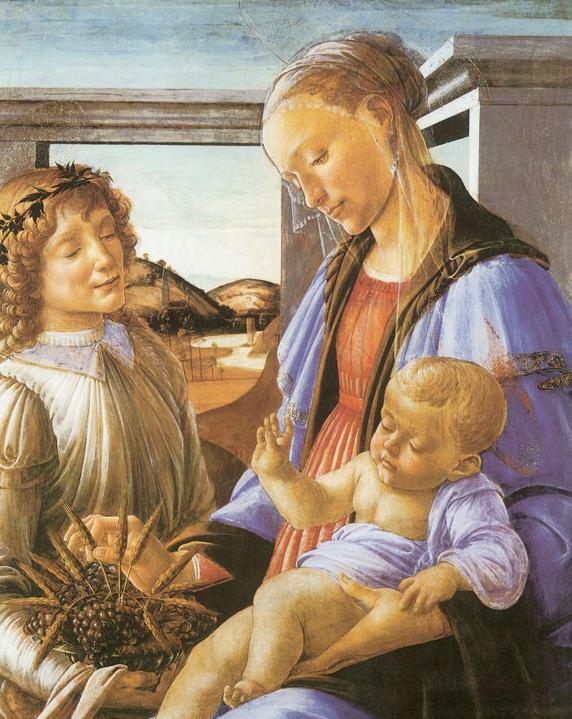
The Madonna Of The Eucharist, Boston, Isabella Stewart Gardner Museum
In the Madonna of the Eucharist an aspect of Botticelli appears in an already perfected form: the Christian symbolical aspect. In it we find plastic form achieved by means of chiaroscuro in a highly developed manner, while the undulating outlines give to the plastic forms the value of movement. But the new element in the picture is the compositional motive. Lippo Lippi had shown that it is possible to derive motives full of decorative grace and homely affection from the association of angels with the Child Christ, the mind of the beholder being thus diverted from the religious character of the representation. Botticelli returns to the religious motive with a seriousness of intention unknown to
Lippo Lippi. The angel is not playing with the Child, but offering him a plate containing ears of corn and grapes, the fruits of His Passion, while the Madonna takes an ear of corn and hands it to her Son. The attention is concentrated on the symbol, and the spiritual element is constituted by the contemplation of the symbol, by the melancholy reflection on the future Passion of which the symbol is a presage, by grief for the fatal sacrifice. The homage of the angel becomes contemplation of the symbol of the Passion. In other words Botticelli frees himself from all action, and aims above all things at 'presentation', though it is clear that in this case the presentation is not in opposition to the representation, but is identified with the representation of something which is not action, not the external reality, but intimate spirituality or, more simply, contemplation.
Source:
Giclée is the name for the extremely high quality printing process that is used for these fine art reproductions. The term refers to the use of an inkjet printer featuring a minimum of 8 different inks, as opposed to standard printers which use 4 inks (CMYK) and the ability to print to a range of standard papers and non standard media, such as canvas. The printers utilise 12 inks enabling the company to reproduce a far wider range of colours and to more faithfully and accurately reproduce the beauty and vibrancy of the original works of art. Archival pigment inks ensure that their Giclée prints have real staying power with a guaranteed minimum lifespan of 100 years. In essence, Giclée printing is the very best method of printing available for fine art reproductions which is why it is the only method they are happy to use for their prints. |