|
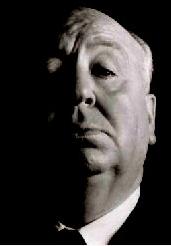
Alfred Hitchcock
Hitchcock: Master Of Suspense Signature Collection [DVD Box Set]
The Lodger
The Pleasure Garden
Alfred Hitchcock's Frenzy :: The Last Masterpiece Book Review
Alfred Hitchcock Peter Ackroyd Book Review
Complete Hitchcock Book Review
Advertise This Page
Search Site
Alfred Hitchcock Dvds @ amazon.com (direct link)
Alfred Hitchcock Books @ amazon.com (direct link)
h i t c h c o c k
Hitchcock's creative genius expressed itself through a series of visual or aural effects - startling conjuring tricks calculated to make audiences gasp or giggle. In the course of his long career - he was born in 1899 and started working in films in 1919 - Hitchcock created hundreds of these moments of virtuosity. He employed trick photography, bizarre settings, striking film and soundtrack editing, and telling single shots or whole sequences that had a fantastic or nightmarish reality of their own. Some of these devices were present in his earliest films, but their full impact was first visible in The Lodger (1926).
This silent film was built largely upon a succession of effects. A quick, impressionistic montage at the beginning showed London terrorized by an unknown Jack the Ripper-like murderer. The opening was followed by a series of 'virtuoso' set-piece scenes which made audiences, at that time not usually aware of the director's hand, realize that here was someone of importance behind the camera. The Lodger's most famous device showed the anxiety of an ordinary suburban family disturbed by the endless pacing of their mysterious lodger upstairs. Hitchcock built a glass floor and filmed from below as the man paced across it - an effect that greatly impressed critics and public in 1926.
His next substantial success, Blackmail (1929), was begun as a silent movie, but by this time cinema audiences were eager to see talking films, so the producers decided to insert a few lines of dialogue into the last reel. This did not satisfy Hitchcock who secretly shot additional scenes for the film in sound.
His gamble paid off: the producers were so encouraged by what he showed them that they allowed Blackmail to be reshot with sound. It was Britain's first all-talking film. Despite the addition of sound and dialogue, Hitchcock retained the silent film's freedom of movement and avoided the danger of making 'photographs of people talking'. It, too, had a show-piece scene which attracted particular attention. The heroine has, half-accidentally, stabbed a would-be seducer to death and returned home just in time to cover her absence. At breakfast the next morning a neighbour chatters about the murder - now reported in the papers: 'What a terrible way to kill a man. With a Knife in his back. A knife is a terrible thing. A knife is so messy and dreadful...' The words run together so as to be almost indistinguishable, except for the word 'knife' stabbing out of its context again and again, as though audibly striking the guilt-ridden girl.
The effect is there to be noticed, and noticeable it is, perhaps at the expense of the rest of the film, since it is rather showy and self-conscious. Nevertheless, at the time it demonstrated to producers, the public and especially the unwilling critics - who looked askance at the new talkie medium - that sound, and even dialogue, could be used creatively. The talkie did not have to be merely a photographed stage play but had other, more exciting possibilities. Blackmail confirmed Hitchcock as the most important and talented British film-maker of the day.
In 1934, he began the great series of six suspense thrillers, made in four years, which carried his reputation round the world and finally took him to Hollywood in 1939. The first of them, The Man Who Knew Too Much, established his penchant for the brilliantly conceived effect as the basis f film-making. A family on holiday in St Moritz witness the murder of a secret agent who, before he dies, tells them of a plan to assassinate a foreign diplomat in London. Realizing this, the enemy spies kidnap the couple's daughter to ensure their silence. The couple have to thwart the villians' plans without police help.
Whereas in The Lodger and Blackmail the tricks had tended to stand out from the overall texture, The Man Who Knew Too Much was virtually a succession of memorable scenes and incidents which kept the audience totally at the director's mercy. This became Hitchcock's hallmark during the Thirties and remained an important part of his style throughout his career..
Not everyone approved - Graham Greene, then influential film critic of the Spectator, wrote of The Secret Agent (1936):
'His films consist of a series of small "amusing" melodramatic situations: the murderer's button dropped on the baccarat board; the strangled organist's hands prolonging the notes in the empty church; the fugitives hiding in the bell-tower when the bell begings to swing. Very perfunctorily he builds up to these tricky situations (paying no attention on the way to inconsistencies, loose ends, psychological absurdities) and then drops them: they mean nothing: they lead to nothing.'
It was curious that Greene, of all people, should have been quite so unsympathetic to what Hitchcock was doing in these films, since it was so close to those stories of his own that he labelled 'entertainments'. Hitchcock was always first and foremost a popular entertainer, with no overt pretensions, leaving others to find deeper meanings in his work. His way of involving his audience was to deploy his unique technical skills and extraordinary inventive faculties in the elaboration of telling incident through specific effect. There are many single shots in the British thrillers which everyone who has seen them remembers. There is, for instance, the famous shot near the end of Young and Innocent (1937) in which the camera travels slowly across a crowded ballroom during a the dansant, moving closer and closer to the black-face band, then concentrating on the drummer and finally pausing in an arresting close-up of his eyes twitching - the crucial identifying mark of the murderer.
But memorable though such isolated moments are, and though Hitchcock enjoyed devising them and making them work, the dramatic effects in his films were usually more far-reaching. There were whole sequences that used or exploited well-known conventions of suspense. Take, for example, the idea of there being 'safety in numbers'. In The Thirty-Nine Steps (1935), the hero, Hannay, hotly pursued by foreign agents, stumbled into a political meeting. Realizing that his only hope of escape was to get up and speak, he delivered an absurd, off-the-cuff speech and made himself so conspicuous that the villians were unable to do anything to him for fear of giving themselves away. Hitchcock liked this idea so well that he later used variations of it in the two American films which had similar chase formulas to The Thirty-Nine Steps, Saboteur (1942) and North by Northwest (1959).
Yet crowds and public places were not always havens from danger - they could also conceal it. The climactic scene of The Man Who Knew Too Much occured at the Royal Albert Hall during the performance of a cantata: the sound of the assassin's bullet was planned to coincide with the clash of symbals at the end of the piece. In The Thirty-Nine Steps, Mr Memory was murdered on stage in full view of the music-hall audience, while, in a superb sequence in Foreign Correspondent (1940), a diplomat, surrounded by umbrella-carrying crowds, was murdered during a downpour. His assassin, posing as a reporter, shot him with a gun hidden in his camera.
Hitchcock arrived in Hollywood in 1939. He still continued to work primarily in the thriller genre, telling his stories in the same strongly graphic style and taking the same infinite pains to set up particular effects. Indeed, there were many critics who complained in the Forties that he became even more self-conscious in his use of gimmicks in order to disguise a lack on inspiration. However, some of the devices did transcend gimmickry even during this comparatively slack period: the idea of shooting, completely against the Hollywood convention of the time, all the exteriors of Shadow of a Doubt (1943) in the real-life town of Santa Rosa, instead of a studio back-lot, paid handsome dividends in terms of authenticity and vivid local colour. Other devices, like employing Salvador Dali to devise the dream sequence in Spellbound (1945), were at least interesting failures.
Despite the success of Notorious, Hitchcock's tendency to allow style to dominate content in his films was still criticized, and it wasn't until his second great period, which ran from Strangers on a Train (1951) to Marnie (1964) that he satisfied the most determined doubters.
Though these films still had surprising effects, such as the fairground strangling of Strangers on a Train portrayed solely as a series of reflections in the victim's glasses which had fallen on the grass, these were normally integrated into the structure of the film. A film may have been dominated by a single effect, such as Rear Windon (1954) with its studied observation of everything outside from the point of view of the temporarily crippled hero. But most of the later films had a new depth, a new disturbing charge of emotion. The feelings may sometimes have been bizarre, as in Vertigo (1958) in which the hero morbidly tries to remake a girl he picks up into the image of his (as he supposes) dead love, or Marnie, where the hero perversely determines to rape a pathological liar and thief into normality; but there was no doubt about their strength and consistency. North by Northwest (1959) and Psycho (1960) were perhaps the best of these later films. The former was a sort of nostalgic harking-back to the world of the British thrillers, while Psycho was the most beamingly brutal, blackest of black comedies, a technical and dramatic tour de force which Hitchcock never surpassed. Almost every scene was a set piece, until one ended by accepting its baroque texture as some kind of crazy standard. However often the spinechilling murder in the shower is seen, it is impossible to be completely prepared, completely impervious to its terrors.
Hitchcock began his career with a young man's fascination with innovation. His sheer delight in putting all his goods in the shop window was in itself infectious. But from Strangers on a Train onwards Hitchcock proved himself a master of his medium, able to integrate his effects into the structure and content of the film instead of being carried away by them.
He wryly observed in Film Review in 1946:
'In the old days of melodrama they used to bring the sawmill in out of the blue - no excuse for it, it was just there when the heroine's neck needed cutting.
'We are more realistic now. It is an age of enlightenment and taste. We make the heroine the daughter of the lumberjack.'
Hitchcock died in Los Angeles, USA in 1980 of renal failure.
Alfred Hitchcock Dvds @ amazon.com (direct link)
Alfred Hitchcock Books @ amazon.com (direct link)
Hitchcock: Master Of Suspense Signature Collection [DVD Box Set]
The Lodger
The Pleasure Garden
Alfred Hitchcock's Frenzy :: The Last Masterpiece Book Review
Alfred Hitchcock Peter Ackroyd Book Review
Complete Hitchcock Book Review
Advertise This Page
Search Site
Top of Page
|



|
|