Like his earlier Rope, this masterpiece
from director Alfred Hitchcock began as
a technical stunt: Hitchcock wondered
if he could make a film on just one
set, from
James Stewart plays a photojournalist
with a broken leg and a high society
girlfriend, Grace Kelly. Confined to his
apartment, he whiles away the time
gazing out of the window through his
telephoto lens and becomes convinced
that a neighbour opposite (Raymond
Burr) has murdered his wife and
chopped her into disposable pieces.
Hitchcock's "stunt" became a classic
study of voyeurism - all those
windows, shaped like movie screens,
each containing a mini-drama of their
own - and the tension builds brilliantly,
complemented by the sexy repartee
between Stewart and Kelly, and the
cynical humour provided by nurse
Thelma Ritter. This extraordinary
achievement has never been equalled.
The set (Thorwald's apartment is on 125 W. Ninth Street) contained 32 apartments. At the time it was the largest indoor set ever built at Paramount Studios. They were all constructed in the studio because real apartments couldn't be lit to Hitchcock's satisfaction.
In reality, there is no 125 W. Ninth Street in Manhatten - it turns into Christopher Street before the numbering gets that high. The design of the apartment block seen in the film was based on a real apartment block which could be found on Christopher Street.
The real-life stretch of road that can be seen behind the apartment block was also the location of the Stonewall gay riots some fifteen years later in 1969.
Aside from a couple of shots near the end and the discovery of the dead dog, the entire film apparently originates from inside Jeff's apartment.
Rear Window is not only a gripping story of murder and suspense, it is a celebrated allegory on the nature of film itself, a story in which the audience watches Jefferies watch the story unfold. The different windows can also be seen as a representation of the emerging medium of television, with Jefferies watching a multitude of 'shows' from the comfort of his own apartment.
L.B. Jeffries (Stewart), a photographer with a broken leg, takes up the fine art of spying on his Greenwich Village neighbours during a summer heat wave. But things really hot up when he suspects one neighbour of murdering his invalid wife and burying the body in a flower garden.
Stewart had nothing against Kelly professionally; on the contrary,
friends Gary Cooper, who had worked with her in High Noon, and Ray Milland, who had worked with her in Dial M for Murder, had sung her
praises. Milland, however, had not left it at that. After an affair with the
actress, who was half his age, during Dial M for Murder, he had pressed
his wife into initiating divorce proceedings so he could marry Kelly. The
future princess of Monaco put an end to the affair before the divorce talk
got too far, but that didn't improve her reputation with Gloria Stewart, Jimmy's wife, who counted Mrs. Milland as one of her closest friends and who had
picked her as Kelly Stewart's godmother. There was little doubt that
Gloria could have gotten along nicely without Stewart working with
Kelly. Even years afterward, the blonde actress from Philadelphia was her
primary point of reference when she touched on the subject of her
husband's beautiful co-stars:
Jimmy was working with some of the most glamorous women in the world
[during the 1950s]. My constant fear I suppose was that he would find
them more attractive than me and have an affair with one of them. A lot
of men in Hollywood became involved with their leading ladies. Jimmy
was a red-blooded American male so naturally I thought it could happen
to him, too. I was convinced it was only a matter of time before the
telephone would ring and it would be James telling me that he had to
work late at the studio or that he would be out playing poker with the
boys. Well, no such phone call ever came. And I can honestly say that in
all the years of our marriage Jimmy never once gave me cause for anxiety
or jealousy. The more glamorous the leading lady he was starring
opposite, the more attentive he'd be to me.
By that criterion, Stewart must have been particularly attentive at the
end of 1953, when he began shooting Rear Window with Kelly. His initial
resistance to another teaming with Hitchcock gave way before several
factors. One was the story itself. Even before admitting that he was
intrigued by a John Michael Hayes treatment of the original Cornell
Woolrich tale, he had heard from old friends Leland Hayward and Josh
Logan that they too thought highly enough of the property to look into
filming possibilities. Another reassurance came with Hitchcock's
promise that Rear Window would not degenerate into Rope II—a
technical exercise that left the actors feeling like supernumeraries on the
set. And, as important as anything, there was the fact that Lew
Wasserman was also Hitchcock's agent. The MCA representative worked
out an elaborate agreement with Paramount that not only guaranteed
the director a core team of his favorite production people over several
films and a top-of-the-line budget for his undertakings, but that, with
specific regard to Rear Window, cut Stewart in for a percentage of the
profits.
If Stewart had reservations about being a surrogate for a cinematic
psychodiary, he had cause to be concerned the very first day of
production when Hitchcock spent a half-hour shooting the shoes of the
Kelly character (an insert never used in the film) and didn't hesitate to
shrug off a query about it with a "Haven't you ever heard of a shoe fetish?"
It didn't take long, either, for it to become evident that the director was
back to the Svengali posture with his female star that he had adopted
during Dial M for Murder and that would lead him to try to "recreate" Kelly in later years with Vera Miles, Kim Novak, and Tippi Hedren. At
another early point, he ordered twenty-seven takes of a shot of Kelly
kissing Stewart on the forehead. But initially at least, the actor had more
worries about the set that occupied an entire Paramount soundstage and
that was the grandest ever built by the studio outside those required for
the spectaculars of Cecil B. DeMille. With Rope-like familiarity, Hitchcock doted on showing visitors how the set consisted of thirty-one
apartments—twelve of which had been completely furnished even
though they were never to be seen except through windows and from a
distant line of vision of the characters in the photographers apartment.
But even in the midst of his enthusiasm for the new toy that his
technical staff had given him, Hitchcock had enough differences from
Rope going for him to allay Stewart's apprehensions of another mechanical slog coming. Most obviously, the enormous courtyard set
had already been built and so, elaborate to the point of excess or not, it
was a stationary object that could not pre-occupy the director to the
exclusion of the story or the actors. Moreover, it was a stationary object
viewed almost totally from the point of view of the Stewart character, in
effect giving him not only the role of a photographer named Jeffries, but
also that of the Rear Window camera. The only exceptions to this double function came when the actor himself was shown on the screen—
making him about as omnipresent as any film performer could hope to
be. With his technical set problems already worked out in pre-production,
it was also a much more amiable, even buoyant, Hitchcock who guided
the Rear Window shooting; in contrast to the frayed filmmaker who had
drunk even more than Stewart during Rope or the nasty one who had
once cracked after Milland had flubbed a line in Dial M for Murder:
"I
wind it up and put it on the floor—and it doesn't work!"
The director of
the Woolrich suspense tale struck everybody as being happy and eager at work. However much that had to do with being at the crest of his
professional (equaling personal) relationship with Kelly, nobody contradicted Stewart for saying afterward that:
"the whole production went smoothly. The set and every part of the film were so well designed, and [Hitchcock] felt so comfortable with everyone associated with it, that we
all felt confident about its success."
For Stewart, the success was in the phlegmatic rendering of a skittish,
self-absorbed man who has not only been laid up by a broken leg, but also
laid low by having to rely for intimate company on two women that his
career—as revealed by the magazine covers of wars and disasters on the
walls of his apartment—would have normally allowed him to ignore
(Stella or fly off from after a couple of rolls in the hay (Lisa). Beneath his
sardonic commentaries on the routines of his neighbors and on the East
Side ambiance of his lover, he conveys a hardness that seems to have
been earned as much from bedrooms as battlefields. The actor's ability to
make himself sound boyishly uncertain about career and marital
decisions chat he has already clearly arrived at works as an inner
supporting layer to the structure of the story as a whole—sustaining the
kind of a suspense that glamorous fashion models from the real world no
less than homicide cops from the real world would have dissipated far
more quickly. It is a performance by an actor very comfortable with his
powers at the center of what is essentially a lavish seediness.
The seediness has little to do with the voyeurism that countless critics
have attached to the character of the protagonist over the years. The
voyeurism reading, in fact, is redundant and evasive when it isn't
irrelevant altogether. It is redundant because, as a photographer, Jeffries is conceded as a professional voyeur from the beginning. It is evasive because it pretends that photographers disabled for a long period would
have "more normally" spent their hours reading Ralph Waldo Emerson or
watching the cooking programs and old westerns that a 1950s television
set would have entertained them with. It is irrelevant because Stewart's
Jeffries carries a much more loaded supply of straightforward misogyny—-
at least toward wives—than of Peeping Tom self-indulgence; or, as he
attempts to be ironic in celling Lisa at one juncture, the disadvantages of
being married include, immediately before the threat of having to deal
with a nagging spouse, the problems of having to cope with garbage
disposals.
Not surprisingly, Hitchcock always preferred the critical interpretations revolving around the voyeurism key. For one thing, it enabled
him to take after the hypermoralists who decided that Jeffries's snooping
made the whole picture immoral. To these guardians of virtue he liked
saying:
"That's nonsense. Nine out of ten people, if they see a woman
across a courtyard undressing for bed or even a man pottering around in
his room, will stay and look; no one turns away and says its none of my
business. They could pull down their blinds but never do; they stand
there and look out."
Especially in his later years, he also liked tantalizing
interviewers who saw the voyeurism motif as fundamental to interpreting
Rear Window as being primarily a self-critical commentary on his own
career as a movie maker; that is, the director as autobiographer, a la
Ingmar Bergman. In this he was helped no little by public perceptions of
him (fostered especially by his popular television series in the 1950s and
1960s) as somebody drolly detached from the absurdities of Hollywood
filmmaking and as somebody more inclined to the surfaces of sexual
naughtiness than to the depths of sensual obsession. The Master of
Suspense, as he was known, played, and had decades of masterful but still
basically light entertainments to prove it. Thus when Raymond Burr's
wife-killer, arguably the most sympathetic character in Rear Window ,
bursts in on Jeffries at the end to ask pitifully, "What do you want of me?
Tell me what it is," he is more diplomatically understood as a neighbor
who has been espied in his underwear or as an assistant director looking
for a job than as a role model for the marriage-abhorring Jeffries (or for
all the other wife-killers who figure prominently in Hitchcock pictures).
Along with The Glenn Miller Story, Rear Window gave Stewart two of
the five highest-grossing Hollywood films of 1954. It proved as successful
abroad as at home. In January 1955, Japanese riot police had to be called
out to clear the Hibuya Theatre after unanticipated thousands turned
out for the opening of the picture attended by the actor and his wife. In
good part thanks to the celebrity of the princess of Monaco, the picture
did even better during a European rerelease in 1962.
As Gloria Stewart had feared, Kelly had not left her husband
indifferent; in fact, aside from Margaret Sullavan, he has probably never
praised an actress more openly or more consistently. Asked about her
supposed coldness by one interviewer, for instance, he replied:
"She was
anything but cold. Everything about Grace was appealing. I was married,
but I wasn't dead. She had those big warm eyes and, well, if you had ever
played a love scene with her, you'd know she wasnt cold. She had an
inner confidence. People who have that are not cold. Grace had that
twinkle and a touch of larceny in her eye."
Enough twinkle and larceny for the actor to agree at once to co-star
with Kelly again, under the direction of Josh Logan, in Designing Woman,
a comedy about the volatile marriage between a fashion designer and a
sportswriter. But with the sets already going up, Kelly announced her
retirement from acting in order to marry Prince Rainier III of Monaco.
Stewart was offered Lauren Bacall as a substitute, but indicated the
depth of his expectations in reteaming with Kelly by also pulling out of
the project. Some years later, he noted to an interviewer that Designing Woman, as directed by Vincente Minnelli with Bacall and Gregory Peck,
had been a commercial hit, voicing regret that he had withdrawn from
the film. It was one of the few times, he said, that he had "let my heart
rule my head."
>
£7.00
Dvd Available Elsewhere: amazon.co.uk (direct link)
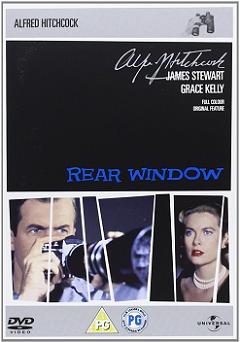
--------------------
rear window review
--------------------
rear window buy dvd
--------------------
alfred hitchcock biography
--------------------
advertise this page
--------------------
search site
--------------------
movie review
one single vantage point.
---------------------------
The weather is getting hotter, and photographer L.B. Jefferies (James Stewart) is stuck in his apartment with a broken leg and nothing to do--that is, nothing to do but spy on his neighbours through their open windows across the way in the apartment complex. There's an attractive and scantily clad dancer, a songwriter, a lonely woman, and the Thorwalds (Raymond Burr and Irene Winston), a bickering couple, among others. But when Mrs. Thorwald disappears, Jefferies is sure that something's wrong. Soon, despite the
warnings of his girlfriend Lisa (Grace Kelly), and his motherly nurse Stella (Thelma Ritter), Jefferies has out his binoculars and telephoto lens and is studying his neighbour 'like a bug under glass.' However, looking in from the outside might not be as safe as Jefferies assumes.
---------------------------
Alfred Hitchcock amply demonstrates why he's been called "The Master of Suspense" with this both witty and macabre tale of voyeurism and murder starring two of cinema's all-time favourites, James Stewart and Grace Kelly.
---------------------------
When
the director mentioned that the project he had in mind was another
single-set tale and was based on a relatively obscure short story, the
doubts increased. Then, too, there was the impression of many in the
movie industry at the time that, following such stale or even disastrous
productions as Under Capricorn, Stage Fright, I Confess, and Dial M for
Murder, Hitchcock had lost much of his creative energy. But if Stewart
needed an excuse to put down the phone altogether, it was when the
filmmaker indicated that he was on the verge of signing Grace Kelly for
the female lead.
Few Hollywood films have lent themselves to reductionist analyses
more than Rear Window. The voyeurism suggested by the central
character has been the least of it. Various things have all been divined in one line of dialogue or another.
Cineastes have found it to be a parody on the moviemaking process, the
politically minded have discerned in it a commentary on the spying
mentality fostered by McCarthyism, and the sociologically inclined
have squeezed their chins over the exact meaning of the social mix represented as living in the apartment house watched by the photographer. Lending comfort to almost all such readings at one point or another
was Hitchcock, who could be as voluble about his work as any director who
ever lived. Some interviewers have taken him at his word. Others have
taken the word as only a distraction from a waddling neurosis too good to
be true. All have found it hard to abstract the conflicts of his pictures from
the rotund and gelatinous little man whom James Mason once called "a squishy eunuch" and whom Hitchcock biographer Donald Spoto saw as
casting Stewart for protagonists he considered himself to be and Cary Grant for the ones he would have liked to have been.
buy dvd
(Shipped from UK)
(Price includes UK postage & packaging only. To reserve please e-mail here (ihuppert5@aol.com). I will then e-mail you within 24 hours with methods of payment, special features for Dvd, subtitle info, cast details and technical details. From me to you, Hitch fan to Hitch fan, if there are Hitch questions or related to him then just ask and I'll do my best to answer, wherever you are...

rear window review
--------------------
rear window buy dvd
--------------------
alfred hitchcock biography
--------------------
advertise this page
--------------------
search site
--------------------
Page created by: ihuppert5@aol.com
Changes last made: 2015