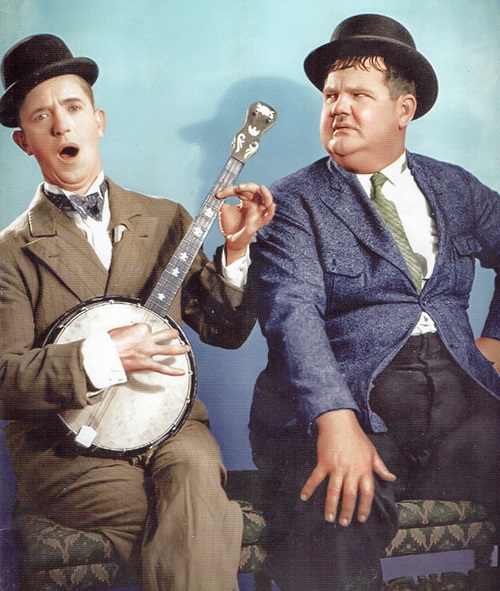
STAN LAUREL Biography (1890 - 1965) More: Details Photo ©: Rex Icon. Biography | Oliver Hardy | A Haunting Review | Dvds/Reviews | Laurel & Hardy Video On Demand: Rent or Buy | Search Site "You can lead a horse to water, but a pencil must be led." Biography Stan Laurel (1890-1965), born Arthur S. Jefferson. Stan Laurel autographs, photographs and more @ ebay.com (direct link to signed items) - just checked and a great selection Laurel & Hardy, without doubt the best-loved and most enduring comedians of the twentieth-century, with a unique range of trademark mannerisms and catchphrases. Vagabonds strolling through life vicissitudes, the pair (well, Ollie mainly) had aspirations to better things in life, but about the most their characters usually achieved in films was a suburban bungalow and nagging wife: 'Look out! it's the wives!" became just one of themany phrases they had only to utter to setaudiences gigging. Stan Laurel was a skinny Lancashire lad who became a skilled pantomimist in his teens and, after years with FredKarno's riotous stage troupe, came toAmerica with them (Charlie Chaplin was their leading comic) in 1910. Thecompany broke up when Chaplin left it totry his luck in films after a second US tourin 1912. Stan Laurel stayed in America.With various partners, he played successfullyin vaudeville for the next five years, changinghis name from Stan Jefferson to Stan Laurel around 1915. He was spotted for filmcomedies in 1917, and gained some successas a character called Hickory Hiram. Irregularities in Laurel's private life (thewoman he lived with was unable to obtain adivorce) led to a couple of estrangementsfrom the morals-conscious Hal Roach, whohad hired him in 1917 and again in 1922.But the lady, actress Mae Dahlberg, returned to her native Australia in 1926, and Stan married another actress, Lois Nielsen,whereupon Roach took him back. The highmindedness of Roach, however, was to be arunning sore in his relationship with thefree-living Stan, and years later was to leadto the premature decline of the Laureland Hardy partnership. The Comedy World of Stan Laurel Paperback Book - Extensively Scanned - Smartphone Page. His Life Biog. Oliver Hardy was a plump, outgoing kid from Georgia,fascinated both by his fellow man - 'Iwould sit in the lobby of my mother's hoteland just watch people go by' - and by thesmell of show business, who ran away fromhome at the age of eight for a life as a boysinger in a travelling minstrel show. Hereturned home in time for at least part of aproper musical education at the AtlanticConservatory. 'They were impressed I couldhit high C.' His mother moved to the smallGeorgia town of Milledgeville when Hardy was 18, and he opened a cinema there for aliving, managing it for three years. In 1913he decided to try and break into films, andwent to nearby Jacksonville where he hungout at the Lubin studios until they took himon to do odds and ends in comedy shorts at5 dollars a week. As the years passed, Hardy played the villain or "second banana' orsimply straight man to dozens of screencomedians, including Bobby Ray, HarryMyers, Billy West, Jimmy Aubrey and, mostnotably, Larry Semon, to whose Scarecrow he played the Tin Man in the 1925version of The Wizard of Oz. Hardy brieflytried making a living as a cabaret singer in1917 but soon returned to films. By 1918 hewas being billed as Oliver 'Babe' Hardy,having acquired his lifetime nickname andhis new legal first name (after his father)around the same time. He was under longterm contract to Hal Roach when Laurel arrived back at the studio in 1926 and thelong-standing partnership between themgradually evolved. Between 1927 and 1940,the team made around 90 films, mostlyshorts, at the Roach studio. They becameat once kings of escalating mayhem - especially in their early shorts - and a kindof comedy of personal relationships, whichmight be termed 'intimate idiocy'. At thesame time 'the boys' (as most of their directors apparently called them) began developing individual 'gesture' trademarks thatrarely failed to make their fans laugh. Laurel had the head scratch, which often indicatedbewilderment. Then there was the prolonged eye-blink, which indicated a concentrated and unhappy attempt at thought.There was also the ear-wiggle and the skipwhen running, and he would sometimesresort to crying when bullied by Ollie oversome misdemeanour. Most of Hardy'smannerisms stemmed from what he himselfcalled 'the courtly behaviour of a southerngentleman'. There was the tie twiddle,usually when he was embarrassed, theflourish of the derby hat when preparing todo something (it was subsequently consignedto the crook of his arm), the imperious waveof his arm when indicating to Stan that he,Ollie, was to go first (normally headlong intodisaster) and of course the famous set of'camera looks', which involved the camerafocusing on Ollie's look of horror, exasperation or faint puzzlement at something Stan has done. One thing that always provedbeyond the Ollie character was the expertise Stan possessed in physical 'magic', not onlywith the ear-wiggle, but blowing on to hisfinger to raise his hat, the handlock withmiddle fingers sticking out in oppositedirections, the kneesie-earsie-nosie routine(involving pulling his nose with his left handand his left ear with his right hand simultaneously) and, with the help of specialeffects, the striking flame with a thumb andfinger. But Stan himself was always defeatedby a simple thing like folding his arms, theinterlocking of the arms somehow escapinghim until they dropped to his sides. Withsound films, which Laurel and Hardy tookmore in their stride than any other silentcomedians, came the catchphrases. Ollie would admonish Stan 'Why don't you dosomething to help me?' or (after he did) came the most famous of all: 'Here's another nice mess you've gotten usinto.' Stan would invariably reply 'Well, Icouldn't help it', dissolving into tears. Whatever the boys touched was sure to turn toashes in their films and, even when they gotaway with something, nemesis was destinedto catch up with them at the fadeout, whetherin the form of the mad chef from Pack UpYour Troubles or the gorilla in Swiss Miss. Their best feature film from the Roach period was probably Way Out West, in whichthey were unhindered either by an episodicplot or by musical interludes. That is, apartfrom two classical musical interpolations oftheir own, a soft-shoe shuffle to the backingof Chill Wills and the Avalon Boys and arendition of The Trail of the Lonesome Pine that, years after their deaths, became aninternational pop chart hit. Laurel andHardy probably made more end-to-endbelly-laugh short films than any other comicor comics in film history. The most consistendly inventive are (of the silents) Leave'Em Laughing, The Finishing Touch, FromSoup to Nuts, You're Dam Tootin', Two Tars,Liberty, Bacon Grabbers and Big Business and(of the sound shorts) Men o' War, PerfectDay, Hog Wild, Helpmates, Early to Bed, TheMusic Box (their only Oscar-winner), TheirFirst Mistake and Them Thar Hills. Although Hal Roach left the boys to go their own wayin the making of the films (though the menwere equals as laughtermakers, Stan wasthe brains behind most of their ideas), heengaged Stan in a continuous running battleabout his private life, and the two mensevered their association in 1939, with Roach invoking a morals clause in the contract. Laurel and Hardy did sign to maketwo further Roach films on a two-off basis,but then formed their own productioncompany. It was never to make a picture.Rather than go back to Roach where, despiteadvancing years, they might have found afew more major films within their capabilities, the boys signed up with major studios,MGM and Fox, whom they soon found tobe far more intractable than Roach everwas. The result is rattier like watching goodTV comedians, say Britain's Morecambeand Wise trying to perform on thescreen. Without the intimacy and rime fortrying out gags, their impact is completeiymuffled. And so it was with Laurel andHardy. Of their 1940s films, only NothingBut Trouble has a few funny moments, andthese are formula action-slapstick stuff.Within the cocoon of the Roach organisation, however, Laurel and Hardy hadalways seemed real characters. They couldbe antagonistic towards each other butalways presented a united front against acommon foe. And their reactions towardseach other always seemed genuine, neverfeigned. Hardy's opinion of the team bearsthis impression out. 'We had a lot of fun anddid many, many crazy things in our pictureswith Roach. But we were always real. Evenin our shortest pictures, we tried to be real'. Stan was married five times in total, twice to Virginia Ruth Rogers. From his first marriage to Lois Neilson, he had two children. His only son died 9 days after birth in 1930. When Oliver Hardy died of cerebral thrombosis in 1957 at the age of 65, Stan suffered a nervous breakdown and according to his friends, never fully recovered. He pledged he would never perform again. Despite offers, he never did. Stan Laurel died of a heart attack on 23 February 1965 at Santa Monica, California, USA. He is interred at Forest Lawn (Hollywood Hills), Los Angeles, thousands of miles away from where it all began, his birthplace in Ulverston, Cumbria, UK, where, to this day, he remains the town's favourite son. Reviews Shop VIDEO ON DEMAND - RENT OR BUY: Icon. Biography | Oliver Hardy | A Haunting Review | Dvds/Reviews | Laurel & Hardy Video On Demand: Rent or Buy | Search Site | Top of Page © Lenin Imports E-mail |